2care2teach4kids
  • Home
  • About
  • Resources
    • Records & Data >
      • Child Info Forms
      • Assessment Forms
      • Progress Reports Learning Portfolios
    • Communication >
      • Parent Notes
      • Calendars
      • Newsletters
    • Curriculum Supplements >
      • Theme Enhancements
    • Learning Environment >
      • Classroom Management
      • Learning Centers
      • Classroom Decor
  • Outdoor and Nature-Based Learning
    • Research
    • Program Models
    • Instructional Practices >
      • Educator Role >
        • Getting Started
      • Curriculum >
        • Whole-Child
        • Program Characteristics Infants Toddlers
      • Observation and Assessment
      • Learning Environment and Materials >
        • Learning With Natural Materials
      • Diverstiy, Equity, and Inclusion
    • Implementation >
      • Safety and Risk
      • Equipment and Gear >
        • Gear List
      • Professional Development and Training
    • Environmental Literacy
    • Explorers Club
    • Reference List: The Outpost

Guidance & Discipline

Positive guidance approaches to discipline should be used in early childhood programs. So whether you're implementing Responsive Classroom, Whole Brain Teaching, PBIS, Pyramid Approach, Conscious Discipline, or a combination of strategies... You will find resources here that complement any positive behavior support system.

Creating Community

The foundation for developing a community of learners where children feel valued, included, and have a sense of belonging begins by building positive relationships between everyone in the group or classroom. There are several factors that will help build a strong classroom community where everyone cares for each other and the classroom.

To create a strong classroom community educators can:
  • Ensure all children and their families feel represented in the materials, books, and curriculum. This means more than just having dolls with different colored skin, it means looks for ways to expand representation of the children and their families throughout the program. Invite families in to share about their family and culture. Include families in planning and decision making. Support families who speak other languages by having materials translated when possible. 
  • Have an open-door policy that lets parents know they are free and welcomed to join the group whenever they want and are able. Help parents who want to be involved to be able to volunteer in the classroom or with program activities.
  • Develop clear, consistent communication procedures and be sure families can access the information they need about your program.
  • Intentionally teach social-emotional skills. Social-emotional skill development can be woven into all parts of programming. Young children need opportunities to learn and practice pro-social skills and problem-solving.
  • Help children take responsibility for themselves and the classroom by involving them in developing the rules for the group and giving them jobs to do to care for things and people in the classroom.
  • Get curious about behaviors when children are struggling. Help children learn the skills they need to cope with emotions, navigate social interactions, and solve problems constructively. Approach it as a learning opportunity for you, the child, and the entire group. Help the other children understand the needs of the child who struggles, as the whole group works to support the child and what skills they need to learn. Be a community of learners!
Three children standing in a circle embracing each other.

Setting Classroom Expectations

Setting expectations in a group setting is probably one of the most important pieces of a successful classroom management system. Children need clear, simple, easy-to-remember expectations that they can follow every day!

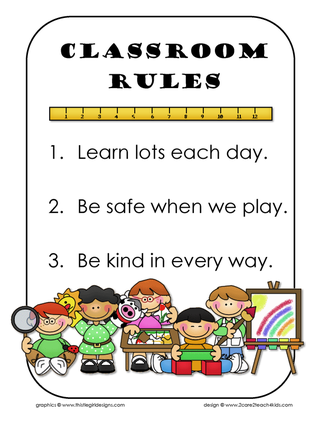
It is important to involve the children in setting the group's expectations. The children and I would always come up with a list of "Rules" they think we should have in our classroom. We talk about how we can state them in the positive and come up with a list we can all agree to... which always comes down to these three main rules. We talk about what it means to be a learner, to be safe, and to be kind. It can be a great project to invite older toddlers and preschoolers to help create signs or pictures of the expectations to hang in the program. Refer to them daily and "read" them together.

A great way to help the children internalize these "rules" is to ask them to "act them out." Practice together what it looks like to "be a learner." Have the children model what a learner looks like while listening to a story or receiving directions for an activity.  Talk together about how to "be safe" in the places where they play and learn, whether that is your classroom, home, playground, or outdoor area. Model kindness and point out when you see kind actions happening. It is helpful to read books that highlight kindness so children begin to understand what it means to practice kindness.

​Read more about creating classroom rules in the Responsive Classroom Approach!
Picture of two children sharing a toy.
Picture of a classroom rules sign.
Simple Classroom Rules Sign
File Size: 151 kb
File Type: pdf
Download File

Build Predictable Routines

Young children thrive when they know what to expect. This includes knowing what will happen and when. Program leaders and teachers can develop predictable group routines and practices that will help the children feel competent and secure. Just as an adult uses a calendar to know what is "coming up" in their schedule, a young child will benefit from knowing what comes next and anticipating any changes. 

Important things to consider when structuring a predictable routine include:
  • Minimizing transitions as much as possible. Try to provide long stretches of playtime so children can deeply engage in their learning. Having to stop playing when you are just getting into a groove can be upsetting for children.
  • Alternate active and passive play and learning times. Young children should not be expected to sit for long periods, so having story time right after snack time might be difficult. Try incorporating a higher-energy activity, like dancing or playing outside, before or after a passive activity, such as meals or storytime. 
  • Post a visual schedule that you can refer to and share with the children each day about what will happen that day. Prepare them for changes by discussing beforehand what will happen and the expectations for the group. 
  • Be flexible; there will be times when the needs of the group might change. For example, it might be a beautiful day outside, so you stay out longer; however, if storytime always happens after outdoor time and before lunch, try not to skip it- maybe just read a shorter story or let the kids know you will read the story at lunch. Try to maintain the same flow, even if you need to be flexible with the timing. 
  • If a routine is not working, don't be afraid to try something new, but be sure to give it a chance first. It takes time for the children to learn a routine, so don't give up too easily. Switching things all the time can cause insecurity in children and affect their behavior.
Picture

Social Emotional Learning

The key to supporting behavior in young children is helping them build strong social-emotional skills. Children need opportunities and practice developing prosocial skills such as:
  • Empathy
  • Sharing
  • Problem solving
  • Critical thinking
  • Self-regulation
  • Perspective taking
These are all skills that need to be developed. Expecting a toddler to just know how to share is like expecting a 9-month-old to just know how to walk. These are skills that take time to develop. Educators can provide opportunities for children to have experiences that promote the development of their prosocial skills. Play-based learning is an important feature of early childhood programs that provides these opportunities for learning. 

Social-emotional curricula can also be included in program plans to help foster children's skill development.

See the additional resources for examples of social-emotional curricula available, as well as other resources for supporting children's behavior and development. 
 

Additional Resources

National Center for Pyramid Model Innovations: Learn more about this national model for supporting social-emotional learning for young children. There are curriculum resources and research-based strategies and practices.

Guidance and Challenging Behaviors (NAEYC): The National Association for the Education of Young Children has a series of articles and resources on positive behavior guidance.

Understanding and Managing Young Children's Behavior: from the Office of Head Start. A great list of resources and articles.

Second Step Early Learning: A research-based social-emotional learning curriculum.

Finding Social-Emotional Curricula, From the Center for Early Childhood Mental Health Consultation: This article has a list of early childhood social-emotional curricula. 

Picture
Founded in 1996 by Kelly Kazeck
as a resource for early childhood educators.

Connect on Social Media

© COPYRIGHT 1996-2026. ALL RIGHTS RESERVED.                                                                        Terms of Use | Disclosure Statement | Privacy Policy |Credits
  • Home
  • About
  • Resources
    • Records & Data >
      • Child Info Forms
      • Assessment Forms
      • Progress Reports Learning Portfolios
    • Communication >
      • Parent Notes
      • Calendars
      • Newsletters
    • Curriculum Supplements >
      • Theme Enhancements
    • Learning Environment >
      • Classroom Management
      • Learning Centers
      • Classroom Decor
  • Outdoor and Nature-Based Learning
    • Research
    • Program Models
    • Instructional Practices >
      • Educator Role >
        • Getting Started
      • Curriculum >
        • Whole-Child
        • Program Characteristics Infants Toddlers
      • Observation and Assessment
      • Learning Environment and Materials >
        • Learning With Natural Materials
      • Diverstiy, Equity, and Inclusion
    • Implementation >
      • Safety and Risk
      • Equipment and Gear >
        • Gear List
      • Professional Development and Training
    • Environmental Literacy
    • Explorers Club
    • Reference List: The Outpost